
Opening
The question is not simply which option costs less.
The better question is:
How do you want the group to behave once it arrives?
An all-inclusive can remove daily friction and make a resort-centered trip feel effortless. It can also create a psychological cost every time the group leaves prepaid food and drinks behind. Paying as you go can create freedom and a stronger connection to restaurants, beach venues, and town life. It can also produce repeated decisions, transportation, fluctuating expenses, and group disagreement.
Choose the operating model—not the marketing label.
The decision in one minute
Choose all-inclusive when
- The property will be the center of the trip
- Predictability matters
- The group wants food and drinks available without repeated payment decisions
- Different people can use the property independently
- Convenience matters more than exploring many outside restaurants
- The exact inclusions are clear and fit how the group actually eats and drinks
Choose pay as you go when
- Restaurants and beach venues are part of the reason to travel
- The group expects to leave the property often
- Flexibility matters more than package simplicity
- Travelers have very different consumption patterns
- You do not want prepaid inclusions to determine where the day happens
Choose a mixed approach when
- Breakfast or selected services at the property are useful
- Several intentional meals will happen elsewhere
- The package terms do not make leaving feel wasteful
- The group understands which charges remain separate
What “all-inclusive” does not automatically establish
The phrase alone does not tell you:
- Which restaurants are included
- Whether reservations are required
- Which menu items cost extra
- Which drinks are included
- Whether room service is included
- Whether gratuities are included
- Whether special events are included
- Whether premium seating or beach service is included
- Whether all travelers in a room must buy the same plan
- Whether the plan applies on arrival and departure days
- Whether age rules affect certain areas
The final booking source and property terms control.
The behavior test
Write down the experiences you already know you want.
Examples:
- Dinner in San José del Cabo
- A long meal at The Office on the Beach
- A high-energy day at Mango Deck
- Nightlife in downtown Cabo San Lucas
- A boat day
- A resort-recovery day
- A private group dinner
Now count the meals and hours likely to happen away from the property.
If the group plans to leave repeatedly, compare the value of flexibility against prepaid inclusions. If the group wants to stay, compare the quality and variety of what is actually included rather than assuming every package is equivalent.
Group dynamics
Couples
The model works when both travelers want similar behavior. If one wants resort convenience and the other wants restaurant exploration, the package can become a daily negotiation.
Families
All-inclusive convenience may reduce decision fatigue, but verify child access, dining times, room configuration, dietary needs, pool rules, and what happens when activities take the family away from the property.
Friends' trips
A package can simplify split expenses. It can also feel unfair when consumption varies sharply. Agree on the operating model before deposits are paid.
Multigenerational groups
Consider mobility, meal timing, room distance, dietary requirements, restaurant reservation systems, and whether everyone can reach the included venues comfortably.
The outside-dining test
Pay-as-you-go travelers should consider more than menu prices.
Include:
- Transportation
- Reservation timing
- Group size
- Taxes and service charges where applicable
- Gratuities
- Currency and payment method
- Time spent moving
- The value of being able to choose the day in real time
The publication will not publish a universal break-even number because prices, inclusions, dates, and behavior change.
The “we already paid” effect
A prepaid package can create a subtle decision rule:
We should stay here because we already paid for it.
That may be exactly what the group wants. It may also keep the group from the Cabo experiences it discussed before booking.
The correct choice is the one that makes the desired behavior easier—not the one that wins an abstract spreadsheet comparison.
Questions to ask before buying an all-inclusive plan
- Which restaurants and bars are included?
- Which items, brands, or experiences carry supplements?
- Are restaurant reservations required?
- Are any venues restricted by age, dress, room category, or plan level?
- Is room service included?
- Are taxes, service charges, and gratuities included?
- What applies on arrival and departure days?
- Can the plan be changed or canceled?
- Does every guest in the room need the same plan?
- Which facilities or events remain separate?
Questions to ask before choosing pay as you go
- How often will the group leave the property?
- What transportation will be needed?
- Which meals require reservations?
- Does anyone need predictable meal access?
- Will the group split checks or manage shared expenses?
- Are food and drinks at the property still available when the group chooses to stay in?
- Is a kitchen or kitchenette part of the stay style?
The Cabo Lifestyle's editorial rule
Do not pay for an operating model that fights the trip you already know you want.
This is an EDITORIAL VIEW. The actual financial comparison must use current property terms and the group's real behavior.
Bottom line
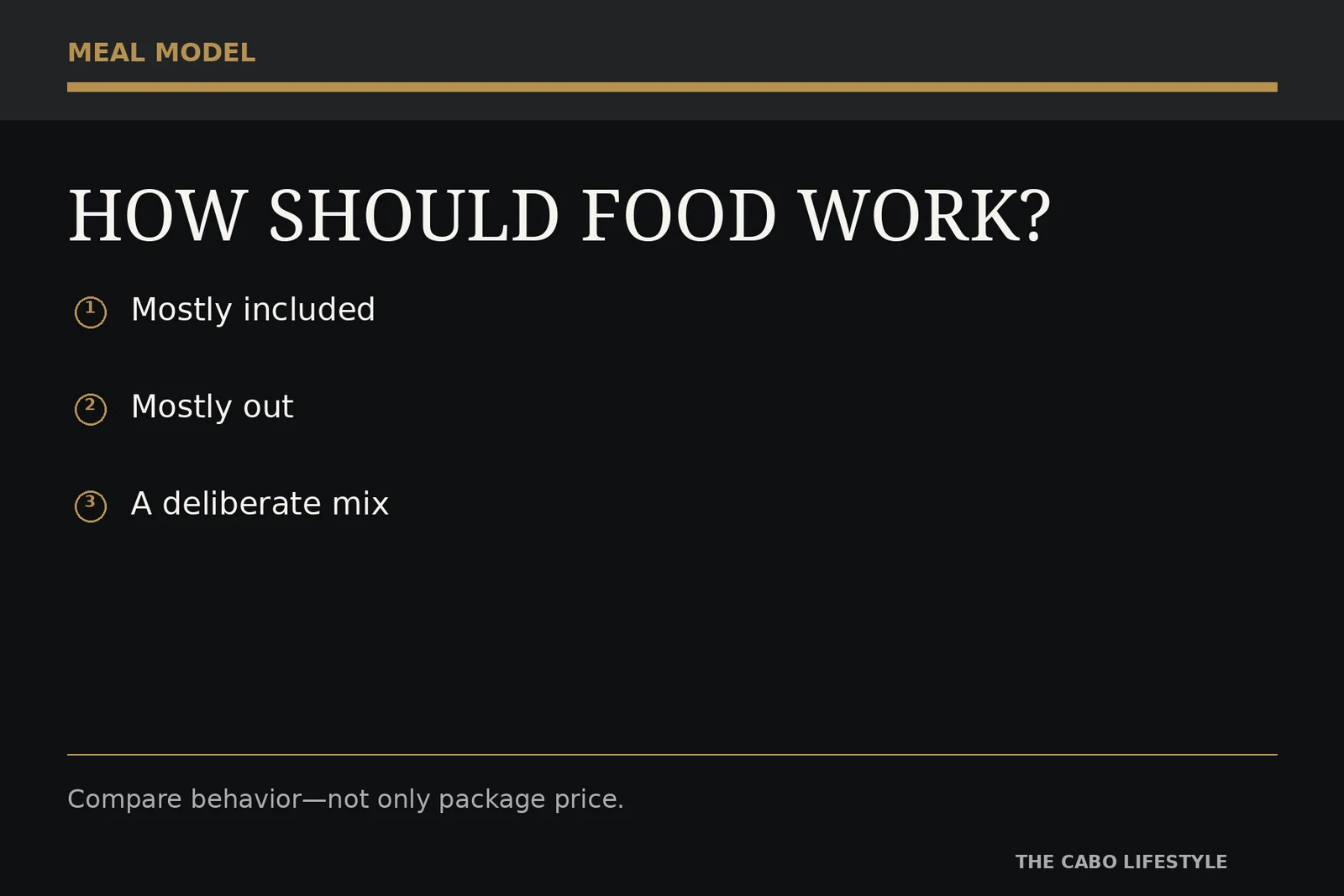
- Choose all-inclusive when the property is the destination and convenience is part of the value.
- Choose pay as you go when restaurants, town, beach venues, and flexibility are central.
- Choose mixed when selected inclusions help without controlling the entire trip.
Calls to action
Related pages
- RESORT, VILLA, CONDO, OR TOWN-BASED STAY?
- CABO SAN LUCAS, SAN JOSÉ DEL CABO, OR THE TOURIST CORRIDOR?
- THE BEST BEACH BARS IN CABO: MANGO DECK AND THE OFFICE
- WHAT KIND OF CABO NIGHT DO YOU ACTUALLY WANT?
- CABO GUIDES, ORGANIZED BY THE DECISION YOU NEED TO MAKE
Source notes
This is an editorial decision framework. Any property-specific inclusion, price, restaurant, reservation, tax, service-charge, or plan claim must use the property's current official terms with a visible checked date.
Freshness control
Review the framework annually. Property examples, if later added, require checks every 90 days and before any commercial activation.